


How the Grid Is Planned to Support Growth, Electrification, and Reliability
What is the Distribution Planning Process?
Southern California Edison’s Distribution Planning Process (DPP) is the formal, recurring planning process to ensure the electric distribution grid can safely, reliably, and efficiently serve customers today and years into the future. The DPP is conducted annually and is refined each year as conditions, policies, and customer needs change.
The annual DPP is designed to:
- Anticipate and identify where electric demand will grow, resulting in existing infrastructure to reach its limits
- Plan grid upgrades before reliability is affected
- Integrate customer projects (including known and pending customer projects), electrification, and DER adoption
- Provide transparent, repeatable planning outcomes reviewed by regulators and stakeholders
What the DPP Is not:
- Not a construction schedule
- Not a guarantee of immediate capacity
- Not a replacement for energization applications or service requests
Inclusion in planning does not equal load reservation — but exclusion from planning significantly increases risk of delay.
Why the DPP Matters to Customers and Communities:
Electric infrastructure takes time to plan, permit, and build. As California experiences: increased housing and economic development, rapid transportation electrification, building electrification and decarbonization, growth in distributed energy resources, the distribution grid must evolve proactively.
Without early planning:
- Capacity constraints may arise unexpectedly
- Upgrade options become more limited
- Customer projects face longer energization timelines
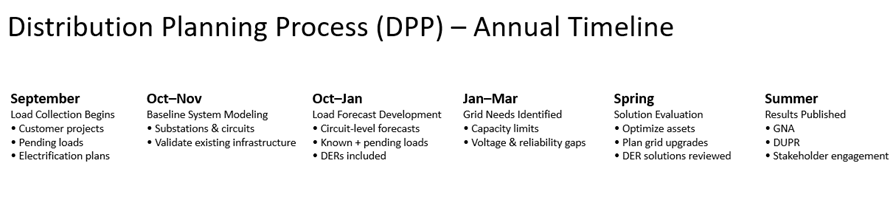
The DPP Annual Planning Cycle (End‑to‑End)
The DPP follows a repeatable annual lifecycle, which is why customer input at any point in the year can still influence outcomes.
Step 1: Load Information Collection
SCE begins by assembling information on current and future electric demand, including:
- Existing customer usage
- Historical demand trends
- Pending customer loads, such as:
- Approved but not energized developments
- Large commercial and industrial projects
- Transportation electrification infrastructure
- Major residential growth
- Distributed Energy Resources (DERs):
- Solar PV
- Energy storage
- Energy efficiency
- State and regional demand forecasts
This information is gathered from multiple sources and mapped to specific locations on the grid.
Step 2: Load Forecast Development
Using this information, SCE develops multi‑year load forecasts, typically covering a 5–10 year lookahead.
Key characteristics of the forecast:
- Demand forecasting is performed at each level of the electrical grid hierarchy, including feeders, substation, and circuits.
- Forecasts reflect:
- Residential and non‑residential demand
- Electrification trends
- DER adoption
- Pending customer projects
- Forecasts are updated annually to reflect new information
Even projects that are still in early planning can affect forecasts if they are shared early.
Step 3: Identification of Grid Needs
SCE evaluates whether forecasted demand will exceed safe operating limits, including:
- Thermal capacity limits
- Voltage performance thresholds
- Reactive power requirements
- Reliability criteria
When limits are forecasted to be exceeded, that location is identified as a grid need.
Each grid need:
- Is traceable through a unique identifier
- Has an estimated timing (when the deficiency emerges)
- Is tied to specific infrastructure
This step allows us to understand where the grid needs to change in order to support growth.
Step 4: Evaluation of Solutions
Once grid needs are identified, SCE evaluates solutions using a cost-effectiveness hierarchy:
First: Optimize Existing Assets
- Load transfers
- Operational adjustments
- Configuration changes
Then: Plan Physical Upgrades
- Circuit upgrades or reconductoring
- New circuits
- Substation expansions
- New substations
- Voltage or reactive power equipment
DER solutions may also be evaluated where appropriate and reliable.
Each option is assessed for:
- Timing
- Reliability benefits
- Cost
- Scalability
Step 5: Public Reporting and Transparency
Results of the DPP are published through:
- Grid Needs Assessment (GNA) – where grid constraints exist
- Distribution Upgrade Project Report (DUPR) – how SCE plans to address them
These annual reports and other planning data are publicly available through public planning portals and stakeholder engagements.
Role of Pending Loads and Early Engagement
The DPP Public Filing emphasizes the importance of pending loads, which capture:
- Projects that are likely but not yet energized
- Electrification initiatives still in development
- Future development identified by local governments and communities
Including pending loads:
- Improves forecast accuracy
- Supports earlier upgrade planning
- Reduces surprise constraints later
Sharing plans early does not lock in capacity upgrades, but it meaningfully improves planning flexibility.
Distributed Energy Resources (DERs)
DERs are small to medium energy resources located close to where electricity is used, rather than at large, centralized power plants. DERs can both affect electricity demand and, in some cases, help support the electric grid.
DERs are included in the DPP in two ways:
- As Load Drivers
- EV charging
- Building electrification
- Electrified equipment
- As Potential Mitigation
- Photovoltaic and Energy storage
- Demand side solutions
- Contracts that defer traditional upgrades
DERs must still meet reliability and performance requirements and may complement - not replace - infrastructure upgrades.
Stakeholder Engagement and Continuous Improvement
Stakeholder feedback informs:
- Forecast assumptions
- Scenario planning
- Methodology improvements
- Process refinements year to year
The DPP is iterative, meaning planning improves as:
- Data quality improves
- Electrification trends evolve
- Customer participation increases
What Customers Should Remember:
- The grid is planned years ahead
- Early information enables better outcomes
- The DPP informs upgrades — it does not guarantee them
- Participation improves transparency and predictability
Early engagement is one of the most effective tools customers have.
Resources:
- Link to DPP Public Filing
- Link to Pending Loads Decision
© 2026 Southern California Edison. All rights reserved.